17 May 2022

Tape recorded music, phone booths onboard train-- Rajdhani Golden Jubilee evokes nostalgia


• Arrangements for playing tape recorded music through the public address system.
• News in Hindi and English from All India Radio, free newspapers to every passenger free of cost.
• Comfort and luxury of passengers looked after by the train superintendent assisted by a steward.
• In a first there was even a STD PCO in the pantry car in the train in 1990s after a tie-up with VSNL

This is what the article in the brochure of the Mumbai-Delhi Rajdhani Express read in the 1970s after it was introduced. In what has been an epitome of comfort, speed and high-class travel, the Mumbai-Delhi Rajdhani Express that completes half a century on Tuesday and will run amid fanfare celebrations with a special postal cover and a VIP album being released on the occasion.


The second among the 25th Rajdhani Express trains that ply today, the Mumbai Central-New Delhi Rajdhani Express—India’s premier passenger train—will flagged off on May 17, 1972. “The service started just three years after the first Rajdhani—India’s first fully air-conditioned train—began between New Delhi and Howrah (Kolkata). The train has constantly been upgraded over the last 50 years to maintain its premier position.


When the train started, it used to take 19 hours and 5 minutes and the journey has now been shortened to 15 hours and 50 minutes between Mumbai and Delhi. Till 1988, Rajdhani, with a maximum speed of 120 kmph, was the fastest in Indian Railways.


On introduction, the Bombay Delhi train ran with a single diesel locomotive of WDM–2 class, later by 1993 on electrification in phases a dual current electric locomotive was used as Mumbai was still under the old direct current traction. Now, with seamless AC traction, a hi-speed WAP class loco is used.


The original train was diesel hauled and after electrification in the early 1990s, the train was hauled by electric locomotives. In 2003, the train was upgraded with new Linke Hofmann Busch (LHB) class coaches designed for a higher speed and improved safety. Now, the train runs with smart Tejas class coaches with automatic door closing facility.

The train’s length increased to 18 coaches from October 02, 1981. The very next year, 1982, saw Mumbai Rajdhani operating four days a week based on the continuously increasing demand. There was no stopping the Rajdhani as the four-days-aweek affair became six days in 1989. The train was also renumbered from 151Dn/152Up to 2951 Up/2952 Dn.

To cater to the increasing demand of passengers along the route, the presentday 12953/12954 August Kranti Rajdhani was introduced on July 01, 1991. It came as an excellent alternative for passengers between the two cities who were finding it tough to get accommodation in the Mumbai Rajdhani. It was in May 15, 1992, when the Rajdhani first began operating with Three-tier AC coaches. And it took just around eight more years for the train to begin running daily from October 02, 2000. On July 19, 2021, Indian Railways inducted the Tejas rake, which has smart coaches with ultra- modern features. Those amenities make the journey all the more comfortable for passengers.


Red & White Train

Superintendent recalls memories

NK Chawla was the train superintendent of the prestigious Mumbai Delhi Rajdhani Express for over 12 years and now retired calls his memories from the iconic train as Red and White, matching the train’s traditional colour shade.


“I joined the Indian railways in 1980 and retired in 2015. I was posted on the Rajdhani Express between 1998 and 2010. I call it the Red and White train. If I think 35 years backwards, I can still see and feel freshly in my memory, the red and white world of Indian Railways,” Chawla, who always used to greet passengers with Jai Mata Di onboard recalls.


Known for his unique dressing style with a spotless white uniform, Chawla said, “As a sign of purity and innocence, I was known for my unique dressing style, as I would embellish myself with white attire and shoes and graciously greet people “Jai Mata Di”. “As most of you already know, Rajdhani Express was and is exotic, elite and special passenger train that connected the financial capital with the country’s capital and travelled the best in it. I recall it has a STD PCO booth in the pantry car,” he said. Chawla remembers accompanying the country’s most important celebrities onboard the iconic train including Dream Girl Hema Malini, Ajitabh Bachchan, Vijayendra Ghatge etc. It was also a privilege to escort India’s deputy prime minister Dr Lal Krishna Advani onboard the train.
“My job profile was to inspect the train before each trip, assisting passengers with directions, luggage, enforcing rules, doing ticket accounting, studying train orders and physical characteristics of the railroad, ready for emergencies or flag exchanges keeping track of work hours,” he added.
Key dates:|

17/5/72 : 151Dn/152Up Rajdhani exp introduced on Mumbai-Delhi Route

2/10/81 : Number of coaches increased to 18, hauled by two\ engines called as Double headed Rajdhani

19/11/82 : Rajdhani exp started running four days a week

1/11/89 : Made six days a week and renumbered as 2951/2952

1/07/91 : August Kranti Rajdhani exp introduced between Mumbai and Delhi*

15/05/92 : 3AC coaches introduced in Rajdhani

2/10/2000 : Rajdhani started running as daily train

15/12/2003 : LHB coaches introduced in Rajdhani Exp

19/07/2021 : Tejas Type Sleeper coaches(First on Indian Railways) introduced in 12951/52 Mumbai - New Delhi Rajdhani Exp

19 November 2019

Found & Lost-- Old bridge relics at Khar Road station

In 2019, on the birthday of Indian Railways that is April 16, while some heritage hunting at Khar Road station on Mumbai division of Western Railway, I had found these relics of the old Bombay Baroda and Central India Railway (BB&CI Railway)

As per records available, Khar station was set up around July 1924 when the Bombay Development Directorate was promoting suburbs in a big way to decongest the island city. The Khar scheme was to be sold to potential buyers and a railway station was a great selling point. After a delay of about a year, the station opened in the monsoon of 1924.

The finding that one sees in the adjacent photograph is that of a few remains of the old iron bridge that was originally in place. This platform is today used by harbour line trains. The bridge had to go as the station expanded to more platforms and the layout of the station changed. (Original Tweet)

On November 14, 2019, I found these relics gone for ever as they had made way for a new staircase. The adjacent photographs are of the same site.

Practically, it was not possible to save them in situ given the crowd at the station and the pressure to build new bridges to offer easy connectivity. The best thing was to document them going and so here are their final pictures.

The Bombay, Baroda and Central India Railway (BB&CI) was a company incorporated in 1855 to undertake the task of constructing a railway line between Bombay and Vadodara in India. BB&CI completed the work in 1864. -- (Pics & text Rajendra B. Aklekar, Mumbai.)


09 November 2019

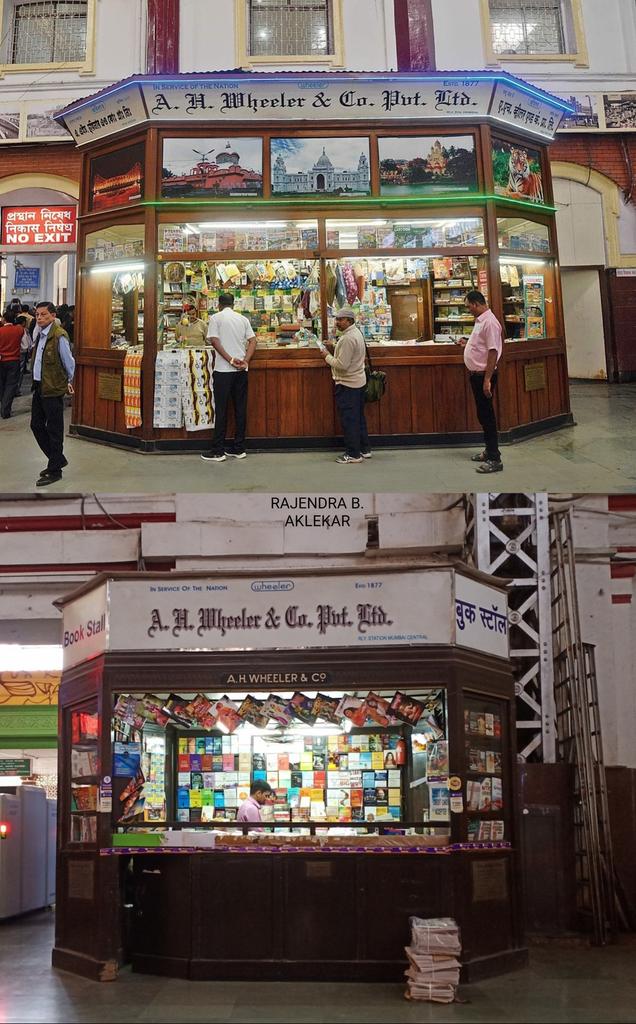
Striking similarities! AH Wheeler stall - Howrah & Mumbai

Striking similarities!

East and West India. The AH Wheeler's railway book stall at Howrah (above) and Mumbai Central (below).

01 June 2019

New book!

FIRST LOOK! Announcing my third book with Rupa Publications The book weaves together anecdotes from 1830s to 2019, taking the reader on a thrilling ride of over two centuries on an 'express' time machine. Enjoy!!! Pre-orders here: https://www.amazon.in/dp/9353332877/ref=cm_sw_r_cp_apa_i_bSe8CbA7B5WRB

26 April 2019

Slow death of original British design at rail stations on first line

The slow death of all the exquisite features of the original British design on India's first railway line. The new standard roof design does not have such finesse.


Wildlife sanctuary at World Heritage Site Railway station

Capturing the wildlife sanctuary in stone on the World Heritage site of Mumbai CSMT, formerly Bombay Victoria Terminus, India.


17 April 2019

Discoveries on Indian Railways' birthday

On the birthday of Indian Railways, some heritage hunting at the Khar railway station today led to stunning discoveries. Formerly Bombay, Baroda & Central India, now Western Railway.


31 January 2019

Restoration of India's WCG2 class Direct Current Locomotive at heritage gallery in Mumbai

FINALLY!!! One of India's last Direct Current locomotives -the WCG2 class - has now been saved at the heritage gallery at Mumbai CSMT by Central Railway Had been personally trying for this for quite some time time. 
My report in MiD DAY today. Click HERE 
--

By Rajendra B. Aklekar

One of the most versatile and common locomotives on the Ghat mountain ranges of Mumbai-Pune and Igatpuri inclines, one of the last of the Direct Current (DC) powered electric engines from the WCG-2 class, fondly called as Howlers for the noise they made, is back at Mumbai CSMT, this time as an exhibit on permanent display to the place where it started all. The other mixed class WCM-1 served till the end of the DC era.

The engine, formally withdrawn from service on 2010, arrived on a trailer truck by road all the way from Kalyan Electric Loco Shed on Wednesday. In its last days, it also hauled a few local trains in Mumbai during the motormen's  strike

"Used mostly to haul freights, do banking duties on the Bhor and Tull ghats (push climbing trains from behind) and rarely haul express trains, the once-common loco with its blue and cream livery with little red stripes was first manufactured in the 1970s," a Mumbai division official said.

Officials said they were the heaviest engines (132 tonne), and powerful ones when launched. 

They were manufactured at Chittaranjan Locomotive Works (CLW) and all the 57 that were built were assigned to Kalyan shed of Mumbai division of Central Railway.

"As of today all these Howler locomotives have been scrapped except one (20158) which had been originally earmarked for preservation at the National Rail Museum, New Delhi.But since Central Railway Mumbai now has its own gallery, the loco has been brought here in the heritage gallery," Central Railway chief public relations officer Sunil Udasi said

This is the second electric loco to arrive at the CSMT heritage gallery after India's first electric locomotive Sir Leslie Wilson was brought here, besides other steam engine from Barsi Light Railway and a few old wagons.


28 November 2018

Narrow Gauge Barsi Light Railway loco in Mumbai

A 1928 vintage Narrow Gauge steam locomotive that once used to run on the 2 ft 6 in (762 mm) Barsi Light Railway (Miraj-Latur) arrived at Mumbai CSMT heritage gully near platform 18 on Tuesday. It has been manufactured by Nasmyth Wilson & Co, Patricroft, Manchester, UK. This is the second engine to arrive at the site, the first one being the first series of electric engine Sir Leslie Wilson that was brought from Kalyan here, besides other artefacts.

17 November 2018

The legacy of Jackson and his railway bank

It was an honour and privilege to accompany Richard Campbell Jackson around the Churchgate heritage gallery and the WR GM bungalow 'Bombarci' as he was nostalgic about his birth city. 

Richard is the grandson of Sir Ernest Jackson, the Agent or the General Manager of Bombay Baroda and Central India Railway, now Western Railway, back in 1925-1932 and founder of the Jackson Co-op Bank used by railwaymen today. 

Sir Ernest was the one who started the Frontier Mail train to give tough competition to the GIP Railway's Punjab Limited.  It was during Sir Jackson's time that the Colaba station was shut and Mumbai Central station was built as it stands today. Also the time when the railway was first electrified.

His grandson Richard, born in the city is today 81, was about 9 years' old when he left Mumbai in 1947. My article on him and some pics.

Click HERE to read complete text of his visit.


If the link did not open, you may read the entire article here:

CAN I see the garden in the backyard? I know there is one," smiled a nostalgic Englishman visiting the spacious bungalow of Mumbai's Western Railway General Manager.

Richard Campbell-Jackson, grandson of Sir Ernest Jackson, who built the then Bombay Central station as the General Manager of the Western Railway, was visiting the city with his wife. "The road in the front was much farther then," the 81-year-old (born in 1937), exclaimed as he took an emotional tour of the bungalow that he lived in decades ago. Named Bombarci, after the old name of Western Railway - Bombay Baroda and Central India Railway (BB&CI) - the spacious bungalow located on Altamount Road, was built in 1925. Sir Ernest Jackson was the General Manager for Western Railway between 1925 and 1932, when he got the (now) Mumbai Central station built along with starting the iconic Frontier Mail train, playing a crucial role in electrification of railways and founding the railway co-operative credit society.
Calling himself a Bombay boy, Richard Jackson, in his first visit to the city since he left it at the age of nine, said that he has vivid memories of the place. "I was born at Malabar Hill and have pleasant memories of the city. I remember the road in front of the bungalow was much farther ahead. It looks so closer now. I also remember the sprawling backyard garden. This has been such a vibrant city and I see that it still remains so," he said. His wife Alison was equally excited. "It's so magical to come here. Richard always wanted to be back in the city he was born in," she told mid-day. Earlier in the day, the two also visited Churchgate and met General Manager Western Railway A K Gupta who showed him old photographs of his grandfather in the railway journals. After looking at the steam engine exhibit in the heritage gallery, Jackson expressed delight. "It is good to know that India is reviving steam engines. It is a very strong movement in England," he said.

 "It is a huge honour for me to revisit [the place] where my grandfather was building the BBCI [now Mumbai Central] and to meet Mr Gupta and his staff. A truly outstanding visit and a unique experience," Jackson wrote in the visitor's book.

Sir Ernest Jackson (also known as Edward) was born in 1876 and arrived in India in 1900 with a posting on the East India Railway and later the Calcutta Port Trust. In 1911, he took the post of Chief Auditor on the Bombay, Baroda and Central India (BB&CI) Railway that is today's Western Railway and later went on a tour of America and Canada as member of Railway Accounts Commission until 1925 when he was appointed as the Agent (now called General Manager) of the Western Railway.

That was a crucial time when the railway was seeing radical changes like getting electrified and quadrupled. The line was cut down from Colaba to Churchgate and a new station building was built at Mumbai Central. Sir Ernest Jackson oversaw all this, but he is more famously known for a bank in his name, the Jackson Co-op Bank at Grant Road that is popular among the railway employees.

He was also instrumental in the rebuilding of the Vasai creek bridge and the iconic Frontier Mail train in 1928. It was started to give a healthy competition to the Punjab Limited run by the Great Indian Peninsula Railway (now CR) playing between then Bombay Victoria Terminus and Peshawar. The Frontier Mail was faster at 72 hours and on its return to Churchgate, the station building was lit to welcome it, again an idea of Jackson.

Jackson’s great granddaughter, Polyandra Stokoe and Richard's second cousin, had visited Churchgate in January 2018. "We were happy to welcome the descendents of Sir Jackson, which evoked much nostalgia. We took them around the heritage gallery and the general manager's bungalow and they were overawed by the legacy," Western Railway Chief Public Relations Officer Ravinder Bhakar said.

rajendraa (@) gmail.com

28 June 2018

Old British design at Mumbai railway stations

Design features of old British railway stations can still be found at a number of Mumbai stations.

20 April 2018

Sir Leslie Wilson arrives at Mumbai CSMT


What a day today! They say life comes a full circle and was a witness to the momentous event today when the Sir Leslie Wilson or EF/1, India’s first electric freight locomotive class that was introduced in 1928 returned home at Mumbai CSMT or formerly Bombay Victoria Terminus station.

I say home because the engine was in active service till 1992 and had spent its lifetime here and after retirement shifted to Kalyan electric loco shed. The engine has now been brought here to be a part of the ‘Heritage Alley’ on World Heritage Day 2018 and will be on permanent display. Sir Leslie Orme Wilson was the Governor of Bombay in 1928 who inaugurated the loco and hence named after him.

It was transported by road, splitting it into three parts that were later assembled here. It features the original livery of India’s first railway company, the Great Indian Peninsula Railway, now Central Railway. EF/1 20067 is one of the two remaining of the class, the other one being at National Rail Museum in New Delhi.